Guide · Venues · 6 min read
Music Curfews and Noise Rules at Mallorca Wedding Venues
The most common surprise for couples planning a Mallorca wedding from abroad: the party can't go on outdoors until three in the morning. Here is why, what the rules typically look like, and how we plan around them — without losing the night.
By SOULBEATFUL ·
Why the rules exist
Most Mallorca wedding venues are fincas, estates and small hotels in residential valleys or villages. Municipalities regulate noise, and venues operate under event licences that set limits on amplified sound outdoors — usually a maximum level and an end time. The specifics vary by town hall and by venue: some allow outdoor music until midnight, some stop earlier, a few exclusive-use estates have more freedom. The venue's contract is the only reliable source for your date.
What it looks like in practice
- An end time for amplified music outdoors — commonly around midnight, sometimes 23:00, occasionally later at private estates.
- A decibel limit measured at the boundary of the property; the band or DJ mixes to it.
- Rules on where speakers may face and whether subwoofers are allowed outdoors.
- Indoor spaces where music can continue later, depending on the venue.
Villages in the Tramuntana (Deià, Valldemossa, Sóller, Orient) are typically strict; estates around Palma and the south-west vary; a private fortress or a finca with no neighbours has the most leeway. Beach clubs and hotels have their own licences.
How we plan a party around a curfew
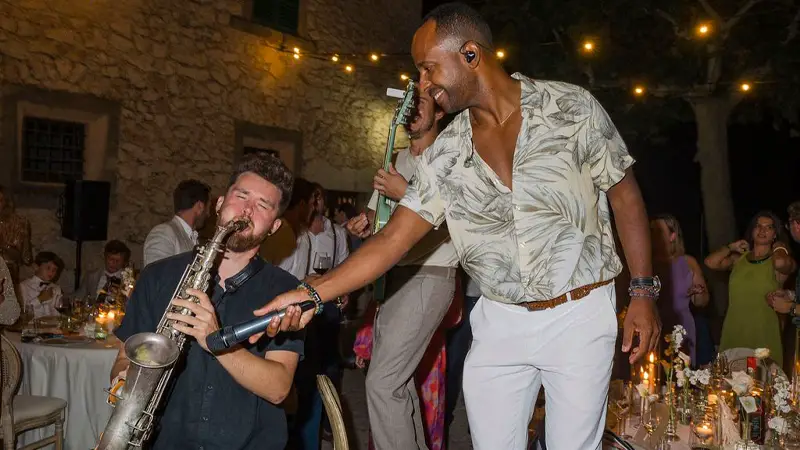
The rule is simple: build the peak of the night before the cut-off. In a running order that means a first dance at the end of dinner, the band or DJ & live combo straight after, the strongest set of the night in the ninety minutes that follow, and a planned continuation at the cut-off rather than a sudden silence.
Continuation options: the DJ moves indoors where the venue allows; the party moves to a second location — a villa, a beach club, a bar in Palma — with the same DJ; or a silent-disco set-up where the venue prefers it. All three work; the key is deciding in advance with the venue and your planner.
See the full wedding music timelineWhy this makes the earlier parts of the day more important
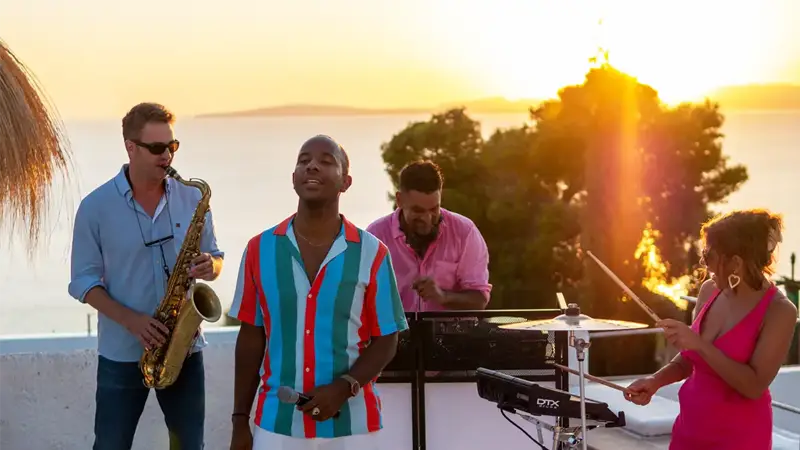
If the party has a fixed end, the ceremony, the cocktail hour and dinner carry more of the musical weight — and they're the parts with no restrictions and the best light. A live singer at the ceremony, a saxophone at sunset and a singer with piano at dinner are not extras on Mallorca; they're where much of the day's atmosphere lives.
Wedding singer for ceremonies and cocktailsQuestions to ask your venue
- What time does amplified music have to end outdoors — and does that differ for ceremony, dinner and party areas?
- Is there a sound limit, and where is it measured?
- Which indoor space can the party move to, until what time, and is it included?
- Can the band and DJ load in early, and where is the power?
- Are there restrictions on subwoofers, lighting or generators?
We ask these questions for every venue we work at, and for the venues we know well we already have the answers.
Venues we work at — with notes on each